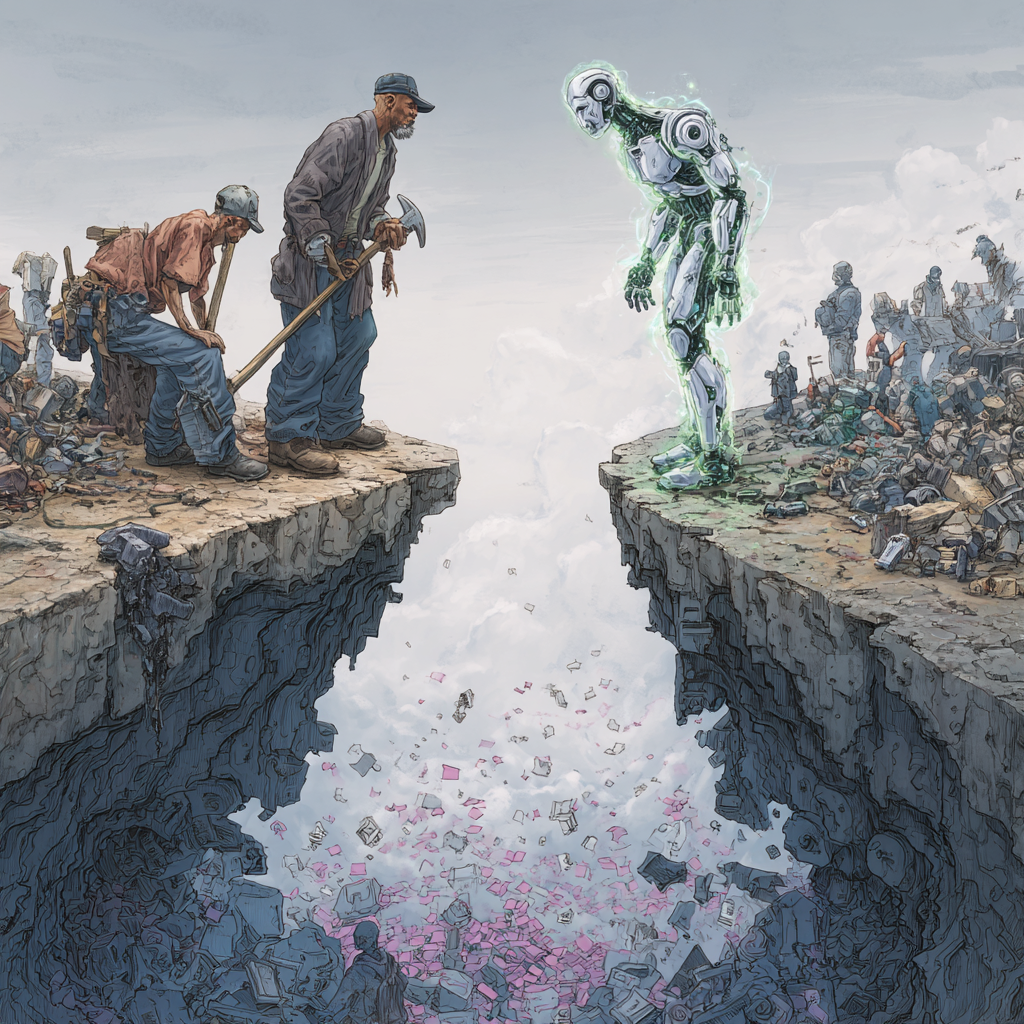
The subject of jobs and automation sparks strong emotions for a good reason—advancements in artificial intelligence (AI) and automation are rapidly reshaping the modern workforce. If this feels like something out of a sci-fi movie, think again. We’re not talking about potential scenarios years down the road. This is happening right now.
From truck drivers to software engineers and call center employees to human resource professionals, today’s workforce stands on a rapidly shifting foundation. The AI revolution isn’t a far-off dystopia. It’s knocking on our door, displacing jobs, reconfiguring industries, and fundamentally altering what “work” will mean in the coming decades.
In this blog post, we’ll break down the history of technological disruptions, where we stand now with artificial intelligence, and why certain groups of workers—especially the economically disadvantaged and individuals with blemished records—may face the greatest challenges. More importantly, though, we’ll discuss actionable ways for individuals to make themselves indispensable in this brave new world.
By the end of this article, you’ll understand how to stay ahead of the automation curve and build a career resilient to the seismic shifts driven by AI.
A Brief History of Labor Transformation
It’s important to frame these changes in context. Disruptions to the labor market are not new. Labor Day itself—a holiday celebrating the achievements of organized labor and improved working conditions—serves as a historical reminder of a time when five-year-olds worked in coal mines to help their families survive.
Today’s working conditions, achieved through advocacy and union efforts led by pioneers like Samuel Gompers, look drastically different. Yet, the driving force behind labor market changes remains the same: technology.
Just like industrialization put untold numbers of manual laborers out of jobs, automation in the 1980s wiped out manufacturing roles that sustained an entire generation of skilled workers. And now, we’re entering the automation age 2.0—powered by AI and robotics, which are replacing not just physical labor, but mental labor as well.
The Current State of the AI Revolution
The Scope of Job Displacement
AI has shifted from being theoretical to an active disruptor of jobs across diverse industries. Consider these staggering numbers:
- In 2025 alone, major tech companies cut over 77,000 jobs, many due to automation and AI proliferation. That’s 495 jobs eliminated every single day.
- Surveys reveal that 14% of workers believe they’ve already lost a position to AI.
The job losses aren’t isolated to a particular field either. Industries across the board, from white-collar roles like human resources and marketing to blue-collar positions in manufacturing, are seeing major shifts. To name just a few examples:
- Microsoft and IBM slashed thousands of jobs, including HR and software development roles.
- An e-commerce company famously eliminated its entire customer support team after deploying an AI bot that was 85% more efficient than humans.
- Back in 2020, MSN replaced its newsroom of human reporters with AI, arguing that even intricate tasks like journalism were dispensable to machines.
What’s most important to note, though, is which jobs are getting hit first—entry-level workers and those already on precarious ground. Disadvantaged groups, people with criminal records, or those lacking impressive credentials often bear the brunt of AI-induced layoffs. The lower you are on the economic ladder, the closer you stand to the chopping block.
Optimism: Will AI Create More Jobs Than It Destroys?
The World Economic Forum, with its characteristic optimism, predicts that while 92 million jobs may disappear due to automation, AI will concurrently create 170 million new jobs by 2025. The catch? These new roles won’t just be high-tech programming or algorithm-heavy jobs; some of them will arise in sectors where human labor is still indispensable—healthcare, agriculture, construction, delivery driving, and nursing.
So while it’s clear AI will continue to disrupt the workforce, it’s also a reminder that not every industry is at risk. Jobs that rely heavily on human-centric skills—such as empathy, communication, leadership, and critical thinking—are still safe, at least for now.
Who’s Most Vulnerable to the Effects of AI?
The landscape is becoming increasingly uneven. Those at the top—the executives and decision-makers—aren’t the ones AI is coming for. The layoffs and automation cuts often hit the most vulnerable:
- Individuals without college degrees or specialized training
- Workers in easily-automated fields like data entry, customer support, and junior design roles
- Economically disadvantaged populations, particularly those who struggle to access reskilling opportunities
- People with criminal records or resume gaps
If your job can be boiled down to repetitive tasks or straightforward workflows, you may be especially at risk for displacement.
Even in higher-paying professions—like software engineering—entry-level workers are finding themselves competing with machine-generated productivity. For example, generative AI tools such as ChatGPT and GitHub Copilot are enabling engineers to automate large portions of coding.
What Can You Do to Stay Ahead?
The good news? While the risks are intimidating, there are practical steps you can take to safeguard your career. By focusing on under-automated skills and developing an understanding of AI itself, you can position yourself as an indispensable worker in any industry.
1. Invest in Human-Centric Skills
Robots are excellent at calculations, pattern recognition, and repetitive tasks, but they still struggle with the nuance required for many human interactions. Focus on developing the uniquely human traits that are hardest for machines to replicate:
- Empathy and Interpersonal Skills: Whether it’s leadership, counseling, or customer relations, roles requiring emotional intelligence are relatively secure.
- Critical Thinking and Judgment: Adaptability and problem-solving cannot yet be fully replaced by algorithms.
- Creative Thinking: Roles that involve creativity, from marketing strategy to product design, remain highly human-centric.
2. Become AI-Literate
AI might seem intimidating, but learning how to leverage it instead of avoiding it can be a game-changer. Even non-technical professions can benefit from utilizing AI tools. Here are some ways to upskill:
- Take free or low-cost courses online. Websites like FreeLearningList.org compile affordable resources to help you gain new knowledge.
- Familiarize yourself with tools specific to your field, whether that’s AI-enhanced graphic design programs, productivity tools for administrative work, or machine learning for data analysts.
- Experiment and collaborate with AI as a productivity partner in your current role. For example, AI can take over repetitive tasks, leaving you free to focus on strategic thinking.
3. Explore Cross-Functional Skills
Diversifying your skill set makes you a more adaptable and valuable employee. For example:
- Learn a second language to expand your communication reach.
- Take up courses on management or collaborative team dynamics—skills that are critical in any organization.
- Gain technical proficiency to complement your soft skills. A hybrid skill set is harder to replace.
4. Take Charge of Your Retraining
The unfortunate reality is that large-scale retraining programs are few and far between. Employers and governments have largely passed the buck, leaving individuals responsible for their own futures. Instead of waiting for a miracle program, take proactive steps to reskill:
- Enroll in community college trade programs or online technical courses that align with high-demand industries.
- Volunteer or freelance in roles that help build new, future-proofed skills.
Conclusion
The AI revolution is here, and it’s moving fast. Employers and governments may not have a roadmap for managing its effects, but that doesn’t mean you’re powerless. By doubling down on human-centric skills, gaining AI literacy, and cultivating adaptability, you can build a career that not only survives but thrives in an increasingly automated world.
The key takeaway? Resilience in the age of AI is rooted in your willingness to invest in yourself. Upgrade your skills, stay flexible, and treat AI as a tool to enhance your productivity, not as an enemy. This isn’t just about staying ahead; it’s about shaping your future with intention.






Leave a Comment